Coming Home to Story

Notes from a journeyman writer, storyteller, and narrative consultant

  • About
  • Books
  • Writing
    • Book Launch
    • My PhD: Unlatching the Gate
    • Readers Say
    • Reviews
    • Selected Poems
    • Stories in Our Bones
    • System-world, Life-world
    • The People of the Sea
    • Drafts
  • Consulting
  • Storytelling
    • Testimonials
    • Island Nights
    • The Storyteller’s Tale
    • An Island Odyssey
  • Men and Storytelling
  • Links

Anyone for coffee?

Posted by geoffmead on November 14, 2012
Posted in: Uncategorized. Tagged: chain stores, Costa Coffee, death of the high street, Lyme Regis, Mary Portas, Totnes. 2 Comments

Don’t get me wrong; I like Costa Coffee. Or rather, I like the coffee they make. I think the “flat white” is a rather good invention (and I wish I knew how to make the fancy leaf shaped pattern in the froth). But – and it’s a big but – I don’t like having a Costa Coffee shop where I live in Lyme Regis.

In the past two years, four chain-store outlets have opened in Broad Street: Costa Coffee, WH Smith, Tesco, and Pasty Presto (Cornish Pasties). We don’t need any of them; we already have a full complement of local tea and coffee shops, a couple of good bookshops, a perfectly serviceable Co-op supermarket, and enough Dorset pasties on sale to feed an army.

Lyme Regis is more like a favourite maiden aunt with a twinkle in her eye and a sly sense of humour than a kiss-me-quick woman of easy virtue. It is Jane Austen, the Jurassic Coast, the Cobb and the Undercliff, boutique shops and B&B’s, that make it worth coming to – not the dubious attraction of well-known brands and chain-stores. How many more of them can we take (four is already too many) before the town loses the unique and quirky character that make it such a popular holiday destination?

The argument against them coming to Lyme Regis is both aesthetic and economic. Not only are they bland (and bland will be the death of us) they suck revenue away from local traders, and the profits they make go to distant shareholders rather than feeding the local economy. “But we are creating jobs,” they say. Are they, I wonder? If there is some truth in this claim, what sorts of job (and under what conditions) are being created?

Not only are these interlopers not needed, they are a thoroughly bad thing for the town. Retail guru, Mary Portas speaks of the “death of the high street” and this – combined with large out of town stores – is how it happens. I’ve no doubt that we’ll be told the council could do nothing to stop them. But it can be done. Totnes has managed to resist Costa Coffee; did we even put up a fight?

Keep such chain-store outlets where they belong: garages, motorway service areas, airports, mainline railway stations – places where predictable products and speedy service are welcome and the environment is already so bland that they could not make it worse.

Make no mistake, we’ll get the town that we deserve. We must support our local shops if we want them to prosper: have our tea and coffee at Amid Giants and Idols; buy our books from Serendip; pick up our groceries from the Co-op (not strictly local I grant you but at least its profits are shared); munch on Dorset pasties in Dorset and save the other ones for elsewhere.
Share this:

  • Share on X (Opens in new window) X
  • Share on Facebook (Opens in new window) Facebook
  • Share on LinkedIn (Opens in new window) LinkedIn
Like Loading...

Leaving Calypso

Posted by geoffmead on November 7, 2012
Posted in: Uncategorized. Tagged: Calypso, Eleftheria, Kapetaniana, Odysseus, Odyssey, Penelope. 2 Comments

As I write these words, I am sitting on the balcony of a studio apartment in the tiny village of Kapetaniana (in Crete) perched high on the southern slopes of a mountain overlooking the Libyan Sea, taking a short break after a week-long storytelling course on the Odyssey with Hugh Lupton and Daniel Morden in Amari.

It was stunning week: inspiring teaching interspersed with visits to Hermes’ Gorge (where we invoked the Olympian Gods); to Pan’s Cave high up on Psiloritis (where the ancient one is still revered); to Rethymnon for a performance of the Iliad by Hugh and Daniel. Add to that, delicious home-cooked Cretan food (apparently there are no Greek words for “I’ve already eaten enough thank you”) and time to dwell in the world of Homer’s Odyssey and you have a recipe for storytelling heaven.

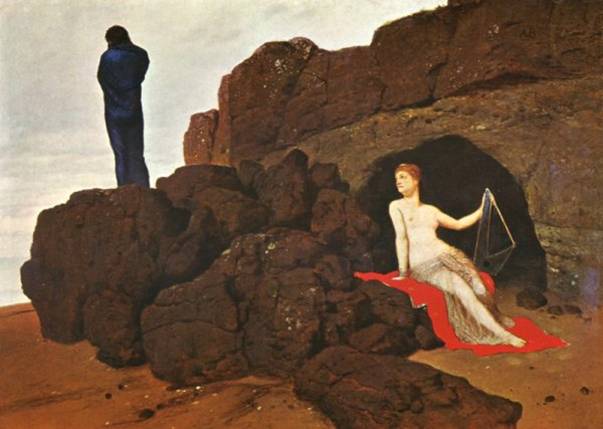
Under Hugh and Daniel’s guidance, eight of us studied the text and prepared for a shared performance of the Odyssey. I was to tell the story of Odysseus’s seven year sojourn with the nymph Calypso and of his eventual escape from her island: Odysseus is rescued from the sea by a goddess who takes him to her bed, provides for all his material needs, and even offers him immortality. Yet when the opportunity presents itself, he spurns her, builds a raft and sails away, back to the land of men and to his mortal wife, Penelope.

I have always been drawn to the fantasy of Calypso’s island. I told the story in Edinburgh last year during the Scottish International Storytelling Festival; I’ve written my own prose version and several poems about some of the key moments; I’ve visited a cave in Gozo that the locals swear was the very one Calypso lived in; 20 years ago I sailed to Ithaca in a 30ft yacht; I have even had real-life relationships with several Calypsos – nymphs who held me in their possessive gaze and promised to love me for ever.

In the end I left them. Not because it wasn’t blissful, but because such bliss was confining and claustrophobic. I left them in the hope of finding a deeper love and a bigger, more meaningful life. I’m fortunate beyond measure to have found both with my partner Chris Seeley (definitely a Penelope not a Calypso). We love each other and support each other in taking our work out into the world.

And yet, some part of me must have felt a degree of nostalgia for my Calypso years because, as I rehearsed the story, Hugh told me that he thought I had not quite grasped the intensity of Odysseus’s desire to leave the island “It’s all a bit too lovey-dovey,” he said.

Hmmmm…

So I changed the language: made it clear that Odysseus only slept with Calypso because she was a Goddess and had no choice; showed him on the seashore pining for Penelope everyday; said how pleased he was to be going home. But still, come the dress rehearsal, two colleagues – Dawn and Mark – pointed out that the tone of my voice was flat when Odysseus left the island: “You say that he is pleased to be going but you don’t show it.” I thought about it over lunch and – over the washing up – found myself asking Stella Kassimati our Cretan hostess to tell me the Greek word for freedom. “Eleftheria,” she said.

That afternoon the whole group told all of Odysseus’s island adventures, book-ended by Hugh and Daniel holding the piece together with a suitable beginning and ending. I told the Calypso story as well as I could and when I described Odysseus sailing away from the island (“open skies above me – open seas before  me”) I opened my arms and bellowed “ELEFTHERIA, ELEFTHERIA, FREEDOM, FREEDOM.” I hadn’t intended to bellow, it just came out that way.

In that instant I knew that I had really left the island of Calypso behind me for ever. I feel no yearning for those days now – a certain fondness and gratitude to the nymphs who loved me  – but no desire whatsoever to return to Ogygia.

Share this:

  • Share on X (Opens in new window) X
  • Share on Facebook (Opens in new window) Facebook
  • Share on LinkedIn (Opens in new window) LinkedIn
Like Loading...

La Luna nel Pozzo

Posted by geoffmead on November 1, 2012
Posted in: Uncategorized. Tagged: clowning, Jacques Lecoq, La Luna nel Pozzo, moon in the well. Leave a comment

A  few weeks ago, I got back home from Puglia in southern Italy. I had gone with my partner Chris for a week of “intercultural clowning” to La Luna Nel Pozzo – The Moon in the Well – a centre for the study and practice of theatre skills run by Robert McNeer and his wife Pia Wachter.

When I say “clowning” I do NOT mean circus clowning with pratfalls, slapstick and painted faces. The clowning tradition we followed was that of the naive, sensitive, open-hearted fool: a red-nosed innocent, constantly amazed, sometimes frightened, and frequently delighted by the accidents and vicissitudes of life.

This kind of fooling is completely improvised: there is no script and no rehearsal. You might be alone on stage, you might be with other clowns. The stage might be bare or there might be props. You might simply cross from side to side, pausing only to stop and look at the audience, or there might be a structure (a suggested situation) to play into.

The essence of such clowning (first developed for the theatre by the great French physical actor Jacques Lecoq) is presence. You learn how doing less is doing more, how to say yes to whatever happens, how to pay exquisite attention to others, how everything is important but nothing really matters, how to let go of your ego and simply “be” on stage even when you don’t know what you are doing. It’s a wonderful training for would-be performers and storytellers.

Actually it’s more than that: it’s a wonderful training for life. In many ways, the archetype of the fool represents the best of us, manifesting our highest potential by bringing us low. Let me show you what I mean by telling you the story that inspired Robert and Pia when they named their centre.

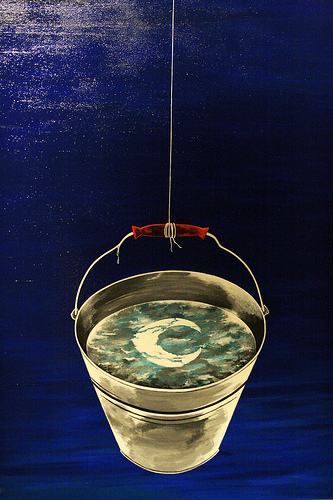
Once, a foolish man went out into his garden at night to draw some water from the well. As he looked over the edge, he saw the moon in the well far below him. He did not realise it was just the moon’s reflection shimmering on the surface of the water.

“Oh, you poor moon, how did you get trapped in my well?” he called out.

He waited for the moon to answer but all that came back was the echo of his own voice. He was horror-struck: the moon must be in a very bad way if she could not even speak.

“Don’t worry moon,” he yelled. “I will save you.”

He grabbed hold of the rope and threw down the metal bucket to fish it out. At first, the moon seemed to disappear as the bucket splashed around but soon it filled with water and he could see the moon clearly again, this time framed by the rim of the bucket.

“Caught you,” he said. “I’ll soon get you out.”

He pulled on the rope and the bucket of water slowly began to rise, swaying and banging on the side of the well as it did so. After a few feet it caught on a stone and stuck fast. The man heaved and heaved but it would not budge. Sweat poured from his brow, his muscles ached and his eyes bulged with effort but he would not give up.

“I never know the moon was so heavy,” he said to himself.

Using all his weight and strength he gave the rope one last enormous heave. The bucket suddenly released itself and flew up causing the man to fall flat on his back and knock himself dizzy.

As he slowly came to, he could see the moon – big and round – floating in the starry sky above him. Tears of joy welled up in his eyes to see the moon back where she belonged.

“O, moon,” he said. “I’m so glad I was able to save you.”

It was an extraordinary week: life as it should be lived. So, thank you to our teachers Robert and Chris for your skill and ingenuity and for holding us as we laughed, cried and played under the Italian sun (and moon); thank you to my fellow British and Italian clowns for your friendship and generosity – especially to Vinnie, whose special way of being in the world taught us so much; and thank you to La Luna nel Pozzo – a place of creativity, connection and healing – long may you prosper.

Share this:

  • Share on X (Opens in new window) X
  • Share on Facebook (Opens in new window) Facebook
  • Share on LinkedIn (Opens in new window) LinkedIn
Like Loading...

Sagrada Familia

Posted by geoffmead on September 26, 2012
Posted in: Uncategorized. Tagged: Black Madonna, crypt, Gaudi, poetry, Sagrada Familia. Leave a comment

My partner Chris Seeley and I spent a few days in Barcelona this summer while we were touring Cataluña. Since our previous visit in 2004, Gaudi’s architectural masterpiece – the Sagrada Familia – had acquired a roof. Although there are still many more towers to be built, the body of the church is more or less complete; it has been consecrated by the Pope and services are regularly held there; hundreds of thousands of visitors troop though its porticos each year to wonder at it.

It is not a cathedral as many people think. Barcelona already has one of those in the old quarter of the city. It was conceived rather as a temple for the expiation of human sins; its full name is Basílica y Templo Expiatorio de la Sagrada Familia. Even before its completion it has been declared a UNESCO World Heritage Site – and with good reason for it is utterly unique and extraordinary: a wild modernist extravaganza of stone and glass. And yet…

And yet, sitting in the nave with my eyes drawn inexorably heavenward and afterwards visiting the more intimate crypt, I found myself much more drawn to the softer subterranean images of the Black Madonna than to the majestic pillars of stone above our heads. These two poems emerged over the next few days as I pondered on this experience.

Templo Expiatorio
It’s glorious one can’t deny,
This pile of carven stone:
A half completed masterpiece
Where God sits on his throne.

The columns rise like fluted trees
Towards the channeled light,
A ploy to make us raise our eyes
To something out of sight.

And thus we stay forever small,
A speck in some god’s eye,
To expiate imagined sins
Until the day we die.

But if we choose to look below,
There we’ll find another:
A Black Madonna in the crypt,
The Eternal Mother.

We don’t have to lift our gaze
To look into her face;
She holds us gently in her arms
And fills us with her grace.

Remember then you holy men
When you do speak of love,
A woman’s heart lies deep beneath
The soaring church above.

Lachryma Christi
There I was in the crypt,
Sitting quietly in the third row,
Trying to look contemplative,

When I noticed some flakes
Of red and pink and beige
Scattered on the front pew.

Two blood-red rose petals,
Like the tears (it is said)
Christ shed on the cross.

The other two petals though,
Were not what I’d expected;
Not petals at all – far from it.

One half-eaten potato crisp
And a soggy sweet wrapper:
Remains of a furtive snack.

But what if some small child,
Seeing the light – had given
Everything that they owned?

Had offered it all to the Lord
In a tumult of religious fervour?
A sacrifice beyond measure.

How do we know the value
Of anything in this world?

Share this:

  • Share on X (Opens in new window) X
  • Share on Facebook (Opens in new window) Facebook
  • Share on LinkedIn (Opens in new window) LinkedIn
Like Loading...

DON’T PANIC

Posted by geoffmead on September 21, 2012
Posted in: Uncategorized. Tagged: A Brief History of Time, Douglas Adams, Hitchhiker's Guide to the Galaxy, Nobel Prize, Stephen Hawking. 1 Comment

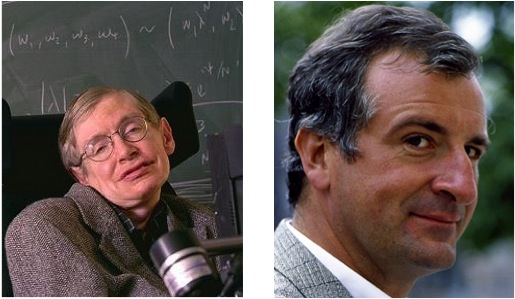
You probably recognise the people in these pictures: cosmologist Stephen Hawking (on the left) and the late comic sci-fi writer Douglas Adams (on the right). You might be wondering why their pictures appear side by side in this blog and what – apart from an interest in matters scientific – they could possibly have in common.

To my knowledge, they share at least three important attributes.

For a start, they both wrote hugely popular and best-selling books which asked questions about life, the universe and everything. Hawking – A Brief History of Time – told us that origin of the question was a singularity whilst Adams – The Hitchhiker’s Guide to the Galaxy – declared that the solution to the question was 42. Given that life is very complicated, the universe is awfully big, and that Hawking and Adams followed somewhat divergent methods, a difference of only 41 seems quite insignificant.

Second, they both extended the theoretical possibilities for space travel. As a space buff since my early childhood, I have been fascinated by the possibility of “boldly going where no man has gone before” since Star Trek was a mere glint in Gene Roddenberry’s eye. Personally, I much prefer the unlimited options for cruising the space lanes provided by the “infinite improbability drive” installed by Adams in Zaphod Beeblebrox’s stolen spaceship Heart of Gold, to the certain prospect of being infinitely (and fatally) stretched by the gravitational effects of one of Hawking’s black holes.

Third (and only now released into the public domain): I went to school with both of them. It would be stretching the truth to say that we were friends (or indeed to claim that I actually knew them) but it is a fact that Stephen Hawking was in his final year at St Albans School in 1961 when I was a first former there, and that Douglas Adams was a new boy at Brentwood Preparatory School in 1960 during my fourth and final year as a boarder there.

I only discovered this recently and I have since been puzzling about its significance (apart from making my name the winning answer to an especially arcane question in a pub quiz).  In particular, I wonder how the course of history might have been changed if only I had introduced them to each other at an early age.

How might our understanding of the space-time continuum have been revolutionised if – through my agency – the world’s greatest scientist and the world’s greatest (at least the world’s funniest) science fiction writer had joined forces? Might it have been humanity (rather than white mice, as Adams claimed) that evolved into hyper-intelligent pan-dimensional beings?

Occasionally, while I am lying awake in the wee small hours, fretting about such missed opportunities for humankind, it occurs to me that having been at the same schools at the same times, we must have had the same teachers. Thus, Stephen Hawking and I would both have been taught Physics by the redoubtable ‘Percy’ Pryke at St Albans School, whilst Douglas Adams and I would both have enjoyed lessons in English (and story writing) from Mr Higgs, the moustachioed headmaster of Brentwood Prep.

But what really keeps me awake at night is the question I can hear you asking yourselves right now: why – when Hawking, Adams and I have such distinguished teachers in common – is the name Geoff Mead so rarely mentioned in the committee rooms of the Royal Swedish Academy when the Nobel Prizes for Physics and/or Literature come up for grabs?

The only explanation I have been able to come up with so far is that I must have nodded off in class during some of the important bits. For which I blame the teachers.

Other suggestions on postcards please to my editor:

Vann Harl
Editor in Chief
Hitchhiker’s Guide to the Galaxy
Infinidim Publications
Ursa Minor Beta

Share this:

  • Share on X (Opens in new window) X
  • Share on Facebook (Opens in new window) Facebook
  • Share on LinkedIn (Opens in new window) LinkedIn
Like Loading...

Ursus Arctos

Posted by geoffmead on September 5, 2012
Posted in: Uncategorized. Tagged: bears, Camping, Pyrenees. 1 Comment

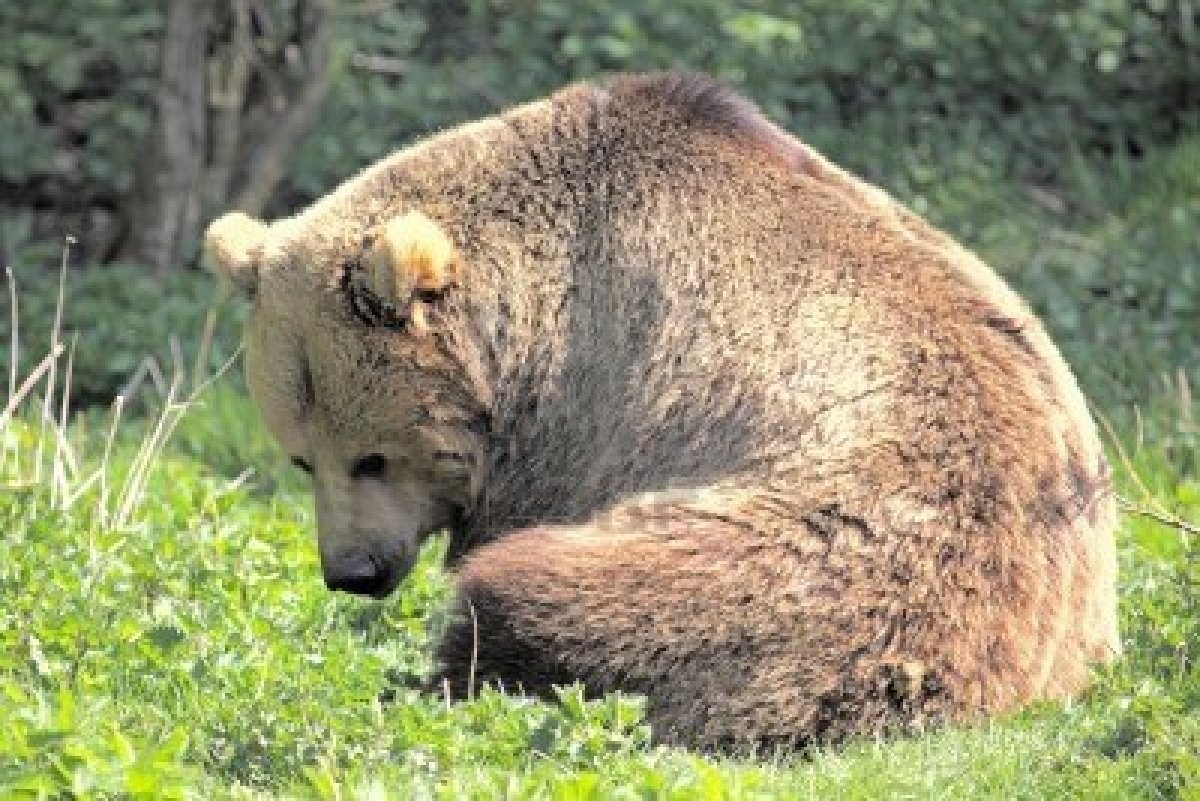
20120905-151632.jpg

It was 3.00 am, we were camping at Mas la Bauma in the Spanish Pyrenees, and I had just been woken up by a female American voice blaring in my ear: “Congratulations. You have just run 9.2 kilometres in a new personal best time.” I was startled – for two reasons: first, I had not just run anywhere, let alone 9.2 kilometres in a new personal best time; second, to the best of my knowledge I had not been sharing my tent with a female American when I had fallen asleep.

This mystery was soon explained by my companion Chris Seeley, who had woken up and decided to read for a while from the e-book on her mobile phone, at which point the Nike GPS app had spontaneously switched itself on and informed both her and me of her running prowess in its distinctively strident female American tones. “Sorry,” Chris said. “It just went off.”

But I digress.

It was 3.00 am and I was – for reasons that are now apparent – wide awake. As I lay in the dark trying to still my jangled nerves, I became aware that we were not alone. The wooded glade in which we had pitched our tent was no longer silent but full of scuffling and mewling sounds; leaves in the branches of the tree above the tent rustled; bits of twig and pine cone pinged and bounced off the taut canvas over our heads; birds flapped and screeched. And amidst this nocturnal cacophony I was quite sure I could hear the undergrowth parting and feel the ground shaking under the heavy footfall of a large bear.

I turned towards Chris and – in the glow emanating from her mobile phone – placed a finger to my lips to caution her to be silent. She looked puzzled so I pointed meaningfully to the side of the tent. “There’s something out there,” I whispered. “Yes,” she said. “We’re camping in the woods. What did you expect?” She returned her attention to her e-book and continued reading with an incomprehensible disregard for our imminent danger.

I felt around surreptitiously in my rucksack until I found my sheath knife which I removed and slid beside me into the sleeping bag. When the bear burst through the feeble canvas barrier – as it surely would – I would go down fighting.

The scratching sounds outside the tent intensified. Then I remembered the bag of food tucked under the flysheet. You were supposed to hang food in a tree beyond the reach of bears weren’t you? I had read that somewhere about camping in North America. Why hadn’t I hung the food in a tree? Why hadn’t I hung Chris in a tree? Elementary mistakes which I was undoubtedly about to pay for with my life.

Lying down seemed to be another mistake: lying down I was a sitting duck. I sat up. “What are you doing?” asked Chris. A question so unnecessary under the circumstances that I refused to dignify it with an answer. “What do you think is out there?” she continued.

“Something big,” I said.

“Oh for goodness sake. It’s just those squirrel things. They’re tiny. I was listening to them for ages before you woke up; quite comforting really.”

Women. Honestly. I ask you. Now I really had something to prove.

“I’m going out,” I said. “For a pee.”

The tent unzipped noisily. I stepped out, ready to meet my maker, magnificently clad in tee shirt, underpants and long socks; the knife – still in its leather sheath – slipped nonchalantly into the waistband of my underpants just in case. The night sky was peppered with stars; the woods were utterly silent. Chris followed me out of the tent in her pink spotted pyjamas. I need one too,” she said wandering towards the bushes. I took a precautionary look around the tent. There was neither sight nor sound of any life form larger than an ant.

“Those squirrel things disappear when you come outside,” Chris called out. “They did last night too.”

We peed (at a polite distance from one another) and returned to the tent.

“Do you think you might go back to sleep now?” said Chris when we had got back into our sleeping bags.

I yawned loudly. “Might have been a bear,” I said sleepily. I didn’t listen for a reply but I thought I heard a faint “humph” before nodding off.

There are bears in the Pyrenees. It said so on the big laminated sheet of local animals displayed at the campsite when I checked it the next morning. Actually, once you deciphered the Catalan script, it said that there used to be bears in the Pyrenees until about 1990 when the last of the indigenous ursine population died out.

All but one, I say.

Share this:

  • Share on X (Opens in new window) X
  • Share on Facebook (Opens in new window) Facebook
  • Share on LinkedIn (Opens in new window) LinkedIn
Like Loading...

Elder Tales

Posted by geoffmead on August 24, 2012
Posted in: Uncategorized. Tagged: Allan Chinen, elder tales, eldership, old woodcutter, storytelling, writing. 6 Comments

If post-heroic stories tell us about the mid-life journey beyond “happily ever after” then – says Allan Chinen (In the Ever After) – elder tales reveal what lies beyond mid-life: it is in them that we may hope to find some guidance for being and becoming an elder.

Until quite recently, I saw myself still caught up in a post-heroic mid-life quest, adrift on the high seas in search of Ithaca. Since turning 60 however, something has changed. I no longer feel that I am searching for some elusive glimpse of what I might become; I am more or less content with who I am and believe that I know what I am here to do.

I feel rather like the old woodcutter in one of Allan Chinen’s elder tales who, after a lifetime of labouring in the forest – his children having grown up and left home – announces one day to his wife that he has had enough of cutting wood. He hangs up his axe and retires to bed from which he cannot be persuaded to rise.

One day a caller asks to borrow his donkey. The woodcutter agrees and the caller (who is in fact a magician in disguise) leads the donkey to a clearing where hidden treasure is buried. The magician retrieves the gold and loads it onto the donkey but is disturbed by a troop of soldiers marching through the forest and runs away.

The donkey, trained by long years of labour alongside the woodcutter, finds its way home and presents its load of sudden and unexpected riches to the woodcutter and his wife. They give a third to their children, a third to the local poor, and the remaining third is more than enough to keep them in comfort for the rest of their days.

The story is full of subtle detail and rich in symbolism. The woodcutter has cared for his family and done his duty all his life. But there comes a time when he relinquishes the struggle – he ceases to strive – and it is only then that he is visited by magic and that riches come to find him. He does not have to search or labour for the gold but the donkey only finds its way home because it has worked alongside the woodcutter for many years. In that sense, the woodcutter’s newfound wealth represents the fruits of his life’s labour.

The tale beautifully illustrates three of the developmental tasks that Chinen attributes to becoming an elder: breaking free of personal ambition (the woodcutter ceases to worry about earning a living); liberation from social customs (he goes to bed and won’t get up); the reclamation of wonder and delight (the return of magic).

As I begin to embrace my age, the stresses of constant work and travel are increasingly irksome. They remain a part of my life but I am gradually learning the value of being quiet and staying still.  And in that still, quiet place I discover that my imagination has more room to breathe and that my creative self can flourish.

The real magic of my later years is to have discovered the delights of writing and storytelling. Like the woodcutter’s gold, they are riches that can only be enjoyed by sharing.

Share this:

  • Share on X (Opens in new window) X
  • Share on Facebook (Opens in new window) Facebook
  • Share on LinkedIn (Opens in new window) LinkedIn
Like Loading...

The Second Half

Posted by geoffmead on August 18, 2012
Posted in: Uncategorized. Tagged: Allan Chinen, Coming Home to Story, Cupid and Psyche, eldership, individuation, Joseph Campbell, post-heroic stories, second half of life. Leave a comment

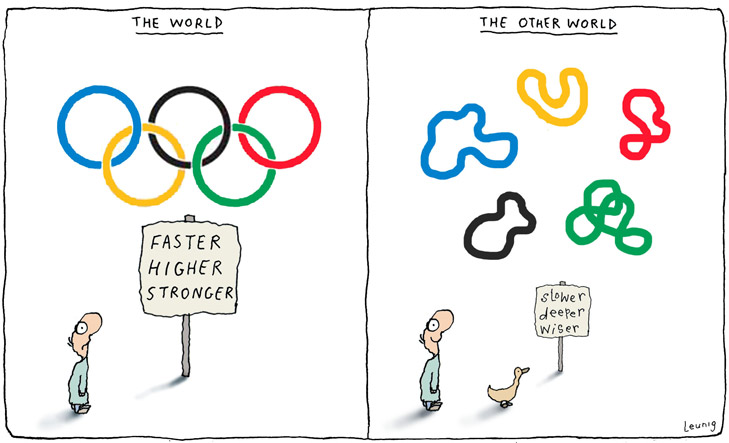
A few years ago, my friend David Green introduced me to the work of Australian Michael Leunig whose cartoons and writings show a unique blend of humour, wisdom and compassion. This particular image was quite widely circulated on the internet during the recent London Olympic Games and I think it speaks wonderfully to those of us in the second half of life: our days of heroic quests may be over but we are still on a journey – albeit one with very different qualities from our youthful adventures.

Recently, I’ve been thinking about how these differences are reflected in different types of traditional story.  Joseph Campbell (The Hero With a Thousand Faces) would have us believe that the hero’s journey is a monomyth: a universal  archetypal pattern for individuation but I have found the work of Allan Chinen (Beyond the Hero, Once Upon a Midlife) to be a richer and more satisfying exploration of our developmental path in the second half of life.

Whereas the hero’s (or heroine’s) youthful quest begins with a call to adventure (e.g. finding the Firebird’s golden feather) and ends with “happily ever after”, the post-heroic quest begins with a fall from grace (e.g. losing the beloved wife or husband) and ends with a sense of “coming home” or finding one’s true self.

The hero (or heroine) overcomes all obstacles by a mixture of courage, magic and luck; the post-heroic figure wins through by a combination of constancy, purpose and fortitude. The object of the heroic quest is known although “impossible” to obtain (e.g. the stag with the golden antlers); the object of the post-heroic quest is much more difficult to locate – often only to be found at the world’s end – and frequently unknown (as in the appropriately named Russian story: Go I Know Not Whither, Bring Back I Know Not What).

The ancient story of Cupid and Psyche as told by Lucius Apuleius circa 160 C.E. is a well-known version of this story-form as is Homer’s Odyssey (in contrast to the heroic tone of the Illiad). The Norwegian wonder tale The Three Princesses of Whiteland  (which I tell and write about in my book under the title of The Furthest Shore) is a particular favourite of mine.

The protagonists of these post-heroic tales are mature men and women, often depicted as kings and queens rather than princes and princesses. They travel to the ends of the world to regain what they have lost and they endure by holding true to what is most precious to them.

The culmination of their long journeys is to become their true selves so that they can live well and wisely for the rest of their days. Although they are not there yet, they are well on their way towards eldership.

Slower. Deeper. Wiser.

Share this:

  • Share on X (Opens in new window) X
  • Share on Facebook (Opens in new window) Facebook
  • Share on LinkedIn (Opens in new window) LinkedIn
Like Loading...

Love and Fear (Part Two)

Posted by geoffmead on August 11, 2012
Posted in: Uncategorized. Tagged: black bears, Brian Goodwin, Centre for Narrative Leadership, love and fear, Lynn Rogers. Leave a comment

In Love and Fear (Part One) I focused on some of the personal insights coming out of the Centre for Narrative Leadership gathering on this theme in early July. In particular, the universal qualities of love were contrasted with the particular fears that uniquely get in the way of each one of us as we seek to express those qualities.

In Part Two, I want to look beyond personal insights to consider the wider consequences of adopting love and fear as existential stances: what does it mean for us to live in the world from a position of love and/or a position of fear?

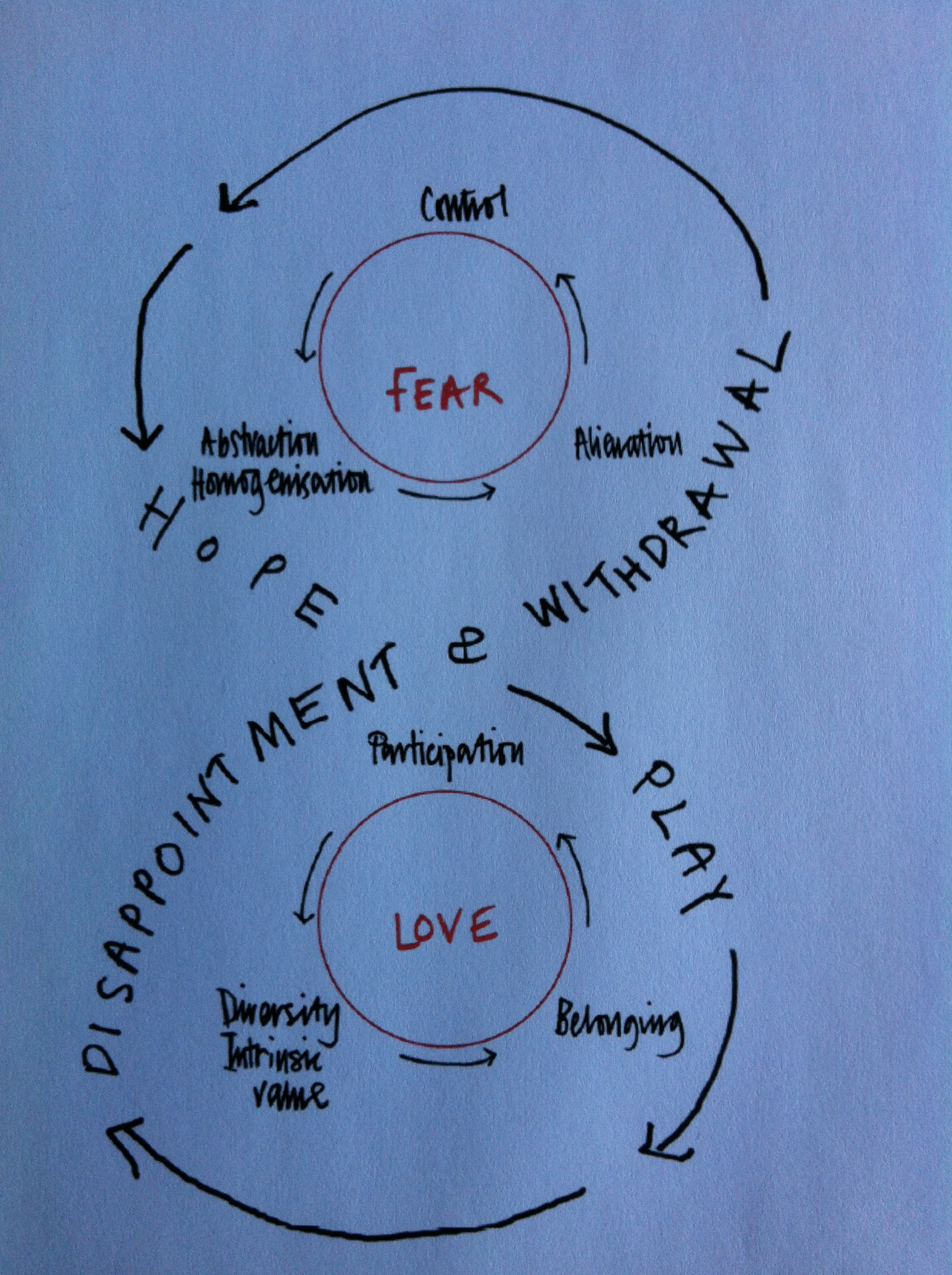
The late Professor Brian Goodwin considered exactly this question at a meeting of the International Futures Forum in November 2001. He summarised the difference in terms of holistic science (primarily concerned with qualities) and enlightenment science (primarily concerned with quantities). The latter – driven by fear – reflects an alienation from the natural world and a consequent desire to control it. The former – driven by love and trust – reflects an intrinsic valuing of the natural world and a consequent desire to participate in it.

Thomas Berry puts this eloquently and memorably as “thinking of the world as a communion of subjects  instead of a collection of objects.” Thus, as I put it in Coming Home to Story, to be human is to participate in the whole of existence: we are merely a part of and not the pinnacle of Creation. We do not have the right to assume dominion over nature but – driven by fear and a desire for control – we have done so for centuries and at great cost!

It would be naive (and potentially dangerous) to believe that we can banish fear absolutely in favour of love. There are circumstances when fear is the most appropriate response: we should be afraid of the charging lion, the armed criminal, the impact of climate change. The trouble comes when we transmute particular and contextual fears into an unthinking existential stance that unconsciously shapes our actions and our world view.

Professor Goodwin suggests a systemic relationship between the polarities of love and fear in the following hand-drawn diagram. Perhaps it can help us find our way to what he calls “an appropriate understanding of the world for the moment you are in – which is the notion of seeking ‘right action’.”

Let me give an example of approaching the natural world from an existential position of love and trust. In 2010, my partner Chris Seeley and I spent 4 days with Dr Lynn Rogers at the Minnesota Wildlife Research Centre deep in the forest.

Dr Rogers has studied North American Black Bears at close quarters for over 40 years. His method is to establish a relationship of trust with wild black bears by giving food (wild bears like an easy meal) and appropriate body language (e.g. not to make direct eye contact). In this way he has been able to place radio collars on selected bears without tranquilizing them and thus to track and observe them closely in their natural habitat. His work has been the subject of several BBC Wildlife documentaries.

Are black bears dangerous? They are certainly stronger than we are and capable of inflicting fatal wounds. But, contrary to scare-mongering myths, black bears are not aggressive if approached in the right manner. Under some circumstances we would be right to fear them but that does not mean that we need to demonise and shoot them indiscriminately.

Fear or love? It is estimated that on average the 750,000 black bears in the United States kill fewer than 1 person a year. An American citizen is actually 16,000 times more likely to be a murder victim than killed by a bear. All this in light of the fact that US hunters legally shoot more than 30,000 black bears each year.

It is time (and there may only just be time) to shift our centre of gravity from fear of the natural world to love. If we do not, the prospects for our planet and all its inhabitants are poor indeed.

Share this:

  • Share on X (Opens in new window) X
  • Share on Facebook (Opens in new window) Facebook
  • Share on LinkedIn (Opens in new window) LinkedIn
Like Loading...

A Path With Heart

Posted by geoffmead on August 10, 2012
Posted in: Uncategorized. Tagged: Castenada, elders, path with heart. 3 Comments

I was approaching 40 before I seriously considered the possibility that I might actually be responsible for the direction my life was taking. I had simply been following my feet until a growing sense of dissatisfaction caused me to look around to see where I had got to and where I was going.

It was then that I encountered the writings of Carlos Castenada. Even now, 25 years later, I can recall the moment, on holiday with my wife and young family at a campsite in the Netherlands, when I opened The Teachings of Don Juan and read the old shaman’s words:

Before you embark on any path ask the question: Does this path have a heart? If the answer is no, you will know it, and then you must choose another path. The trouble is nobody asks the question; and when a man [sic] finally realizes that he has taken a path without a heart, the path is ready to kill him.

There are those who are fortunate enough to begin asking themselves this question early in life but as James Hollis – another favourite writer of mine – says, for most people the first half of life is a necessary mistake. I think it is the word ‘necessary’ that helps us come to terms with what we might otherwise regard as mere youthful folly.

Usually it is not until we approach mid-life that we can begin to sense the unconscious forces that shaped our lives. Only then can we begin to release ourselves from their thrall; only then does the possibility emerge of freely discerning and choosing a path with heart.

And what emerges as a possibility in mid-life feels more like a necessity as we approach elderhood. Indeed, I am wondering if one of the defining characteristics of men and women who become elders (as opposed to merely getting old) is that they insist on walking paths with heart.

Some say that it gets harder to make such choices as we get older because by then we are fixed in our characters and bound by our history to keep on doing what we have always done. But this is to confuse two different things: character and persona. The former is about who we are and the latter about how we show up in the world.

A path has heart if it enables us to show up as ourselves so that, whatever age we are, we can flourish and contribute our unique gifts to the world. As Dawna Markova declares so eloquently in her well-known poem:

I will not die an unlived life
I will not live in fear
of falling or catching fire.
I choose to inhabit my days,
to allow my living to open me,
to make me less afraid,
more accessible,
to loosen my heart
until it becomes a wing,
a torch, a promise.
I choose to risk my significance;
to live so that which came to me as seed
goes to the next as blossom
and that which came to me as blossom,
goes on as fruit.

Reblogged from Elderflowering

Share this:

  • Share on X (Opens in new window) X
  • Share on Facebook (Opens in new window) Facebook
  • Share on LinkedIn (Opens in new window) LinkedIn
Like Loading...

Posts navigation

← Older Entries
Newer Entries →
  • Recent Posts

    • Do Radio
    • Storytelling to touch the Soul
    • Ship of Fools
    • The Compleat Angler
    • Coming Home to Roost
  • Enter your email address to follow this blog and receive notifications of new posts by email.

Blog at WordPress.com.
Coming Home to Story
Blog at WordPress.com.
  • Subscribe Subscribed
    • Coming Home to Story
    • Join 135 other subscribers
    • Already have a WordPress.com account? Log in now.
    • Coming Home to Story
    • Subscribe Subscribed
    • Sign up
    • Log in
    • Report this content
    • View site in Reader
    • Manage subscriptions
    • Collapse this bar
 

Loading Comments...
 

    %d