Coming Home to Story

Notes from a journeyman writer, storyteller, and narrative consultant

  • About
  • Books
  • Writing
    • Book Launch
    • My PhD: Unlatching the Gate
    • Readers Say
    • Reviews
    • Selected Poems
    • Stories in Our Bones
    • System-world, Life-world
    • The People of the Sea
    • Drafts
  • Consulting
  • Storytelling
    • Testimonials
    • Island Nights
    • The Storyteller’s Tale
    • An Island Odyssey
  • Men and Storytelling
  • Links

Tedster The Musical

Posted by geoffmead on May 17, 2014
Posted in: Uncategorized. Tagged: Black Beauty, coming home, love my dog, slo-mo, Ted. 2 Comments

We’ve got a brand-new puppy dog
His given name is Ted
He likes to eat and play all day
And snuggle up in bed

He woofs and wags his happy tail
He licks his furry feet
When there’s a morsel to be found
He sits up for a treat

Yet there’s another side to him
It saddens me to tell
For twice a day he turns into
The puppy dog from hell

He’s got an evil doggy twin
Whose name is Mister Woo
And all the things that Teddy don’t
That Mister Woo do do

He chews your hand and bites your bum
He nibbles on your toes
He elbows in and steals your food
And wrestles with your clothes

He lies down when you want to walk
And then although you beg
He gets a little boner on
And humps your neighbour’s leg

O Mister Woo is not a dog
You’d really want to stay
But when you think he’s here for life
That’s when he goes away

And back comes little angel Ted
Who never makes a fuss
A schizophrenic Cockerpoo
He’s just the dog for us

19 April 2014
Kingscote

Share this:

  • Share on X (Opens in new window) X
  • Share on Facebook (Opens in new window) Facebook
  • Share on LinkedIn (Opens in new window) LinkedIn
Like Loading...

New Stories for Old?

Posted by geoffmead on May 1, 2014
Posted in: Uncategorized. Tagged: catastrophe, new stories, sustainability, Thomas Berry, utopia. Leave a comment

avatar

There are times in our lives when the stories through which we constitute our identity no longer make sense. Illness, bereavement, divorce, redundancy, new job, promotion, relocation, falling in love, marriage, parenthood and other major life events can cause us to question the familiar stories we tell ourselves and others about who we are.

Many of us experience something like this at some point in our lives. At such times our identities are threatened. They can become particularly malleable and open to change but also liable to be frozen defensively. And it’s not just individuals who are affected in this way; the stories that sustain groups, societies, nations, and whole civilisations also collapse.

Deep ecologist and Earth-scholar Thomas Berry once said:

It’s all a question of story. We are in trouble just now because we do not have a good story. We are in between stories. The old story, the account of how we fit into the world, is no longer effective. Yet we have not learned the new story.

Put another way, the old story of the industrial-growth society has passed its sell-by date. We know that it no longer works (indeed that it has only ever worked for a privileged minority) and many of us crave a different kind of social, business and political leadership that is more focused on helping us find new and healthier stories than on propping up the old one.

We are already – collectively and individually – searching for new stories but it seems clear that we can’t go from the old story to the new story without experiencing a dark night of the soul, a place of narrative wreckage, a shifting, confusing time of emptying that will allow something else to emerge. It’s also questionable that we should be looking for the new story at all.

We should not underestimate either the importance or the difficulty of this essential task. It is at times such as these, when old certainties are collapsing, that we are at our most vulnerable to manipulative stories that blame others and promise simplistic solutions.

As John Michael Greer points out in The Long Descent, our situation is not a problem that can be solved but a predicament to be lived through. It calls for grown-up, post-heroic leadership and responsible, adult citizenship. Only then will we end our attachment to the old story and learn how to live well in the “multi-storied” space that exists somewhere between the apocalyptic story of catastrophic collapse and the utopian story of socio-technical or back-to-the-land solutions.

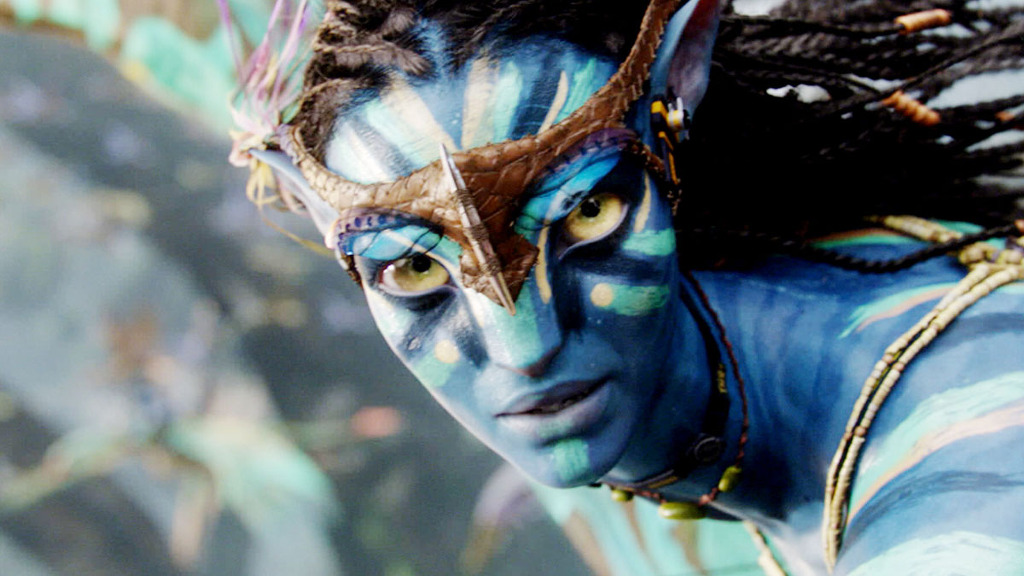
In story terms, the danger is that we will grab on to yet another heroic narrative, hoping that we can put things right with a bit of magic, luck and courage. Hollywood abounds with such environmental blockbusters: The Day After Tomorrow, Avatar, The Core, 2012, to name but a few. They are entertaining adventures but have little to teach us. It’s time to slacken our grip on the Hero’s Journey (always a male archetype) and look to other types of story to guide us. I find myself asking: what stories would we tell if we considered our purpose to be neither destroying nor saving the world but learning to live more beautifully in the world that we have?

Perhaps our stories might resemble more closely something like that told in the award-winning Beasts of the Southern Wild, which shows the very plausible consequences of melting icecaps, massive storms and rising sea levels on a group of misfits, outcasts, and exiles living below the radar in ramshackle huts and boats on the wrong side of the levee in southern Louisiana in a community they call the Bathtub. The film is a blend of magical realism and gritty drama that above all champions the importance of community. People struggle to survive but never forget to celebrate the extraordinary adventure of being alive, finding beauty even in the midst of death and disaster.

It is easy to become dispirited and overwhelmed by the difficulties that surround us; it is so much easier to pretend that they do not exist or to believe that it’s not worth doing anything because nothing we can do will make any difference. Yet we need not lose heart; there is much joy to be found and much good we can do by living more simply and more harmoniously with our planet. We might not be able to change the story in one fell swoop; nevertheless the stories we tell and the stories we live do matter.

This blog first appeared in Guardian Sustainable Business Blog 30 April 2014

Photograph: c.20thC.Fox/Everett/Rex Feature

Share this:

  • Share on X (Opens in new window) X
  • Share on Facebook (Opens in new window) Facebook
  • Share on LinkedIn (Opens in new window) LinkedIn
Like Loading...

The Spaces He Left Behind

Posted by geoffmead on April 18, 2014
Posted in: Uncategorized. Tagged: dream, father, memory. 4 Comments

Dad bigHow can I write about a man I hardly knew? How can I reach into that aching void called “father.” I’ve been trying to recreate him in my imagination most of my life. Dad was an RAF pilot and he died in a plane crash when I was four. All I really know is the shape of the spaces he left behind.

Thirty five years after he died, I arrive at a hotel in Eastbourne with 30 other candidates for promotion. It’s a 3 day Assessment Centre: drafting exercises, problem-solving, psychometrics, interviews, the usual sort of thing. I can do this stuff standing on my head.

The first evening we have drinks and dinner and ease our way into the process by filling out a personal information sheet – who are you; what are you interested in; why do you want to be promoted? It’s just something to give the interview panel a few ideas for questions. It’s not a test. But I struggle with the last bit. Why do I want to be promoted? I know I’m in the wrong job. I’ve always known it.

Other people have shaped my career for years; I’m the blue-eyed boy and I’m on the fast track to somewhere I don’t want to go. I know I shouldn’t be here but I didn’t have the guts to disappoint my boss and say “No.” The truth is that I don’t want to be promoted but now that I’m here, I’ll give it my best shot. It’s a matter of pride to succeed. Give me a race to run and I’ll win it; give me a hurdle to jump and I’ll clear it; give me an obstacle to get round and I’ll smash through it. Failure? I don’t know the meaning of the word.

Why do I want to be promoted?

I make something up and go off to bed for an early night.

And I dream. For the first time that I can remember, I dream about my father. He is flying overhead as I cycle round a village green. I am an adult – the same age as in real life. The plane is some fantastic amalgam of jet fighter and propeller-driven bi-plane. In the dream, I know that my father is the pilot. As I look up, drawn by the droning-whirring sound of the plane, I see it start to fall out of the sky. It happens in slow motion. I know it is going to crash. I try to judge the trajectory and I pedal the bike as fast as I can to where I think it will hit the ground. I want to get there in time. I want to save him. There is only one road and it goes round the village green in a circle. The plane plunges towards the centre of the green. I get off the bike and run towards it. Before I can get there, it bursts into flames and is consumed. The heat is overwhelming. I cannot get close. I am too late.

I jolt upright in bed and wake up drenched in sweat. I can remember the dream vividly. I fall back on the pillows and try unsuccessfully to go back to sleep.

The next morning, I sit in the examination room with the other candidates, each at our own desk. “This is a problem-solving exercise,” says the invigilator – a bearded psychologist named Rick. “All the information you need is contained in the brief. You have one and three-quarter hours to complete the task. You may turn over your papers now and begin.” His words fall away into silence, broken only by the sound of rustling papers and a few sharp intakes of breath around the room. I delay looking at my papers for a minute, trying to settle my mind which is still caught up in last night’s dream. My stomach is tied up in knots. I’m breathing quite fast. Deep breath. Take a deep breath.

I realize that other people are already making notes. I check the clock on the wall. Several minutes have gone by without me noticing. I really ought to look at the papers. Come on, turn them over. I do so. My hands are shaking. I cast my eyes over the first page. It’s something about building an oil refinery. I can make that out but I can’t take in the detail. The words swim, the print is fuzzy. It makes no sense. No sense at all. I can see that there are words and tables of numbers but I cannot make them out. They might as well be written in Cyrillic script. Jesus, what’s going on here?

I put up my hand and indicate to the invigilator that I want to go to the toilet. He nods and I get up and find my way to the bathroom. I lock myself in a cubicle and sit on the bog. I can feel panic rising in my chest, a kind of constriction. I clench and unclench my fists. “Come on. Get a grip,” I tell myself.

Gradually, my breathing slows and the feeling of constriction begins to ease. I realize that I cannot stay there much longer. I stand up and flush the toilet then go over to the wash basin and cup my hands under the cold tap. I slosh my face with the water three or four times and dry myself on the towel – one of those continuous loop towels that you have to turn a handle to use. It fascinates me – the whole idea of a continuous towel – does it really have no end; does it go round and round for ever just getting dirtier; why is it called Initial; whose initials? I catch myself. Shit. This is crazy. I’m going crazy here. I have to go back in to the examination.

I make my way back to my desk. Rick comes over. “You alright?”

I nod.

“You sure you’re not sick or something? You were gone for over 10 minutes”

“No. I’m fine thank you.”

He walks back to his desk at the far end of the room and sits down. I pick up the papers to read them. Now I can see the words. I can see that they make sense but I feel completely detached from them. They make sense but I don’t care what they mean. I try to shock myself out of my detachment by biting the back of my hand. I can hardly feel it.

I sit at my desk for the remaining hour and a quarter pretending to read the papers, picking up my pen and moving it over the page as if I am writing though I make no actual marks. I try to write my name on the first sheet of the lined paper. Surely I can do that? I must be able to write my own name. But I can’t. My hand hovers above the page. Something in me will not let me write.

When the bell sounds at the end of the exam, the room is suddenly filled with the sound of chairs being scraped back, loud exhalations of breath all round: “Phew, I’m glad that’s over” – “ Not so bad” – “What did you think?”

I say nothing. I am the last person to get up from my desk. The others have left the room by the time I walk over to Rick. He is expecting me to hand him my answer paper. He holds out his hand for it but I have nothing to give him.

“Nothing at all?” At first he doesn’t believe it.

“Nothing,” I say. Tears well up in my eyes and I sob – “I couldn’t save him”.

It was hard to face the disbelieving stares of my colleagues when they heard that I had flunked the assessment centre. Some were sympathetic, some pitied me, and a few were contemptuous. For a long time, I carried it inside me as a dreadful failure. “You lost your nerve, you should have been able to do it,” the voice in my head would complain.

But now – twenty years later – I am hugely grateful for the lesson in humility and for all the things that promotion would have made impossible: taking early retirement; completing a PhD; training in psychology; coaching and consulting; running my own business; writing books and telling stories; finding my way into a satisfying life that is truly my own.

I couldn’t save Dad but he saved me.
 

Share this:

  • Share on X (Opens in new window) X
  • Share on Facebook (Opens in new window) Facebook
  • Share on LinkedIn (Opens in new window) LinkedIn
Like Loading...

The Art of Narrative Leadership

Posted by geoffmead on March 30, 2014
Posted in: Uncategorized. Tagged: know thyself, Narrative Leadership, only connect, stand for something, Telling the Story. 1 Comment

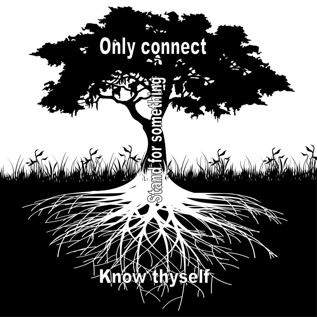
TreeIt is tempting to think that if we just learn the techniques of storytelling we’ll be able to tell a compelling “leadership story” when we need one. But unless we know who we are and what matters to us we cannot authentically stand for anything; unless we open ourselves to other peoples’ stories we cannot expect them to be open to ours; unless we are willing to commit ourselves to something that is grounded in reality and helps people connect with worthwhile purposes we are merely peddling dreams or – worse – trying to manipulate others for our advantage. And these three elements of what I call Narrative Leadership are intimately and inextricably connected.

The metaphor of a tree expresses the relationships between the elements in a lively and dynamic way: the roots of the tree represent the practice of know thyself; the branches and leaf canopy correspond to only connect; the trunk symbolises stand for something. The tree draws sustenance from deep roots which anchor it firmly and enable it to grow: the stronger the root system the greater its potential to support and feed a substantial trunk and an extensive canopy of interconnected branches, twigs and leaves (through which it can absorb and convert light into chemical energy). A healthy tree is able to make the most of the resources and opportunities in its environment, contributing to the eco-system as well as benefiting from it.

Like a tree, our leadership practice grows organically. As we come to know ourselves better, our roots deepen and we tap the source of our sense of purpose and vocation; as we reach out and connect with other people we better understand what the world is calling for; nourished by a sure sense of who we are and what is needed, we can find the courage and determination to stand for what really matters. We flourish and grow as leaders by attending not just to one or two, but to all three practices together.

What is the alternative? Weak rooted trees and people topple in the wind; they wither if they don’t put out branches and leaves; they remain stunted if they don’t develop a strong trunk. Know thyself; only connect; stand for something.

To read more about the art of narrative leadership, read my new book Telling the Story: The Heart and Soul of Successful Leadership published next month by Wiley/Jossey-Bass. Click on the image below to access a special 30% pre-publication discount and to read and download a free sample chapter.

small cover


Share this:

  • Share on X (Opens in new window) X
  • Share on Facebook (Opens in new window) Facebook
  • Share on LinkedIn (Opens in new window) LinkedIn
Like Loading...

The Old Ones

Posted by geoffmead on March 15, 2014
Posted in: Uncategorized. Tagged: first bear, Great Bear, myth, Numi-torum, Ostyak, the old ones, Western Siberia. 2 Comments

Cave-Bears-Chauvet-painting-631.jpg__800x600_q85_crop

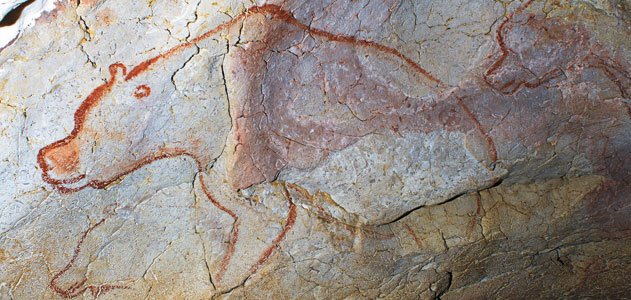
When the world was young, there were no bears on earth, just the Great Bear who lives in the sky with Sun and Moon. Our long-ago, far-away ancestors called him Numi-torum.

During the day he hides behind the clouds but at night you can see him hunting in the northern sky.  With his great strength, Numi-torum rolls the world through the heavens as easily as if he was turning over a log to find grubs. It has always been this way: he pushes us along from one season to the next and each day he turns the Earth around so that Sun and Moon can shine upon us.

Sun and Moon had each other but Numi-torum’s labour was long and he had no companion. Sun and Moon saw how lonely he was and they wondered what they could do to help. Each dawn and dusk as they passed each other they talked about it until one day Moon said:

“I know what we can do. The next time we lie together, we will make a bear-child for Numi-torum .”

Sun agreed and the next time that Moon came to visit him during the day, she climbed into his bed. They cast a silvery shadow over the Earth to preserve their modesty and creation held its breath until they were done. Moon slipped away; daylight returned and the world rolled on.

Next Spring, Sun and Moon presented Numi-torum with the bear-child they had made. Numi-torum was delighted with Little Bear who followed him everywhere. They chased each other across the night sky; they gamboled through the sunlit clouds. They were happy and the world prospered.

Little Bear grew stronger and stronger until one day, as he was playing his favourite game, stalking cloud-puffs and pouncing on them, he accidentally pushed his front paws right through the cloud. He looked around to see if Numi-torum had witnessed his misdemeanour but Great Bear was far away. Relieved, Little Bear edged closer to the hole and peered through it.

Beneath him, unfamiliar colours and shapes glinted and moved. He could see all the people of the Earth, their tipis and their lodges; he could see buffalo and beaver, moose and deer; he could see rivers and mountains, plains and snows, forests and seas. There were so many things, so much going on. Then his nose began to wrinkle as a myriad scents rose up and tickled his nostrils. His heart raced; he stretched his head and neck down the hole as far as he dared, desperate to get closer to the life teeming far below.

When Numi-torum found Little Bear still craning through the hole in the cloud, he guessed what had happened. “I want to go,” said Little Bear. “I want to see for myself. I want to touch it, smell it, hear it, taste it. I want to go. Can I go? Can I?”

Numi-torum did not want to go back to being alone but he also knew that it would be wrong to keep Little Bear by his side for ever. “Things are very different on Earth,” he said. “Down there is life but also death; on Earth you would feel pain as well as pleasure; you would be mortal. Aren’t you afraid to go?”

“I want it more than anything,” said Little Bear.

“If I let you go, you must promise to return to me in the sky one day, either in body or in spirit.”

“I promise,” said Little Bear.

“Then you may go and experience these wonders for yourself. But beware of humans, for some are good and some are bad,” said Numi-torum. “Be kind to those who are good and trouble those who are not.”

So the next night, Numi-torum hugged Little Bear goodbye and let him gently down to Earth on a silver thread. As soon as Little Bear’s paws touched the ground, the hole in the cloud closed behind him, the thread dissolved into moonbeams, and he became not one but many bears, some black, some brown, some golden, some white. Each of them mortal but still carrying the everlasting spark of Sun and Moon, they scattered to the four corners of the Earth to begin their great adventure. All were curious about the world and some were fascinated with humans.

Since then, many bears have been born and many have died and returned to Numi-torum. One day perhaps they will all be gone and Little Bear will have kept his promise. In the meantime, it is said that some of those very first bears are living still and that everything they have seen during their long years on Earth has given them much wisdom and great power. We call them many things: little mother of honey, old man in a fur coat; uncle of the woods; grandfather on the hill; owner of the earth; sticky-mouth; blue-tooth; bobtail; shape-shifter.

They are the Old Ones.

******

My version of an Ostyak (Western Siberian) myth © Geoff Mead 2014

Share this:

  • Share on X (Opens in new window) X
  • Share on Facebook (Opens in new window) Facebook
  • Share on LinkedIn (Opens in new window) LinkedIn
Like Loading...

Take me to your Lizard

Posted by geoffmead on March 8, 2014
Posted in: Uncategorized. Tagged: Arthur Dent, democracy, Douglas Adams, Ford Prefect, Hitchhiker's Guide to the Galaxy, pseudo-democracy, take me to your lizard. 3 Comments

amstrong21-45An extraterrestrial robot and spaceship has just landed on earth. The robot steps out of the spaceship…

“I come in peace,” it said, adding after a long moment, “take me to your Lizard.”

Ford Prefect, of course, had an explanation for this: “It comes from a very ancient democracy, you see…”

“You mean, it comes from a world of lizards?”

“No,” said Ford, “nothing so simple. Nothing anything like so straightforward. On its world, the people are people. The leaders are lizards. The people hate the lizards and the lizards rule the people.”

“Odd,” said Arthur, “I thought you said it was a democracy.”

“I did,” said Ford. “It is.”

“So,” said Arthur, hoping he wasn’t sounding ridiculously obtuse, “why don’t the people get rid of the lizards?”

“It honestly doesn’t occur to them,” said Ford. “They’ve all got the vote, so they all pretty much assume that the government they’ve voted in more or less approximates to the government they want.”

“You mean they actually vote for the lizards?”

“Oh yes,” said Ford with a shrug, “of course.”

“But,” said Arthur, going for the big one again, “why?”

“Because if they didn’t vote for a lizard,” said Ford, “the wrong lizard might get in.”

***

Douglas Adams (Hitchhikers Guide to the Galaxy: So Long and Thanks for All the Fish)

Share this:

  • Share on X (Opens in new window) X
  • Share on Facebook (Opens in new window) Facebook
  • Share on LinkedIn (Opens in new window) LinkedIn
Like Loading...

Imperturbability

Posted by geoffmead on March 5, 2014
Posted in: Uncategorized. Tagged: apprehensivite, freefall writing, imperturbability, insurmountability, kryptonite, super powers. 1 Comment

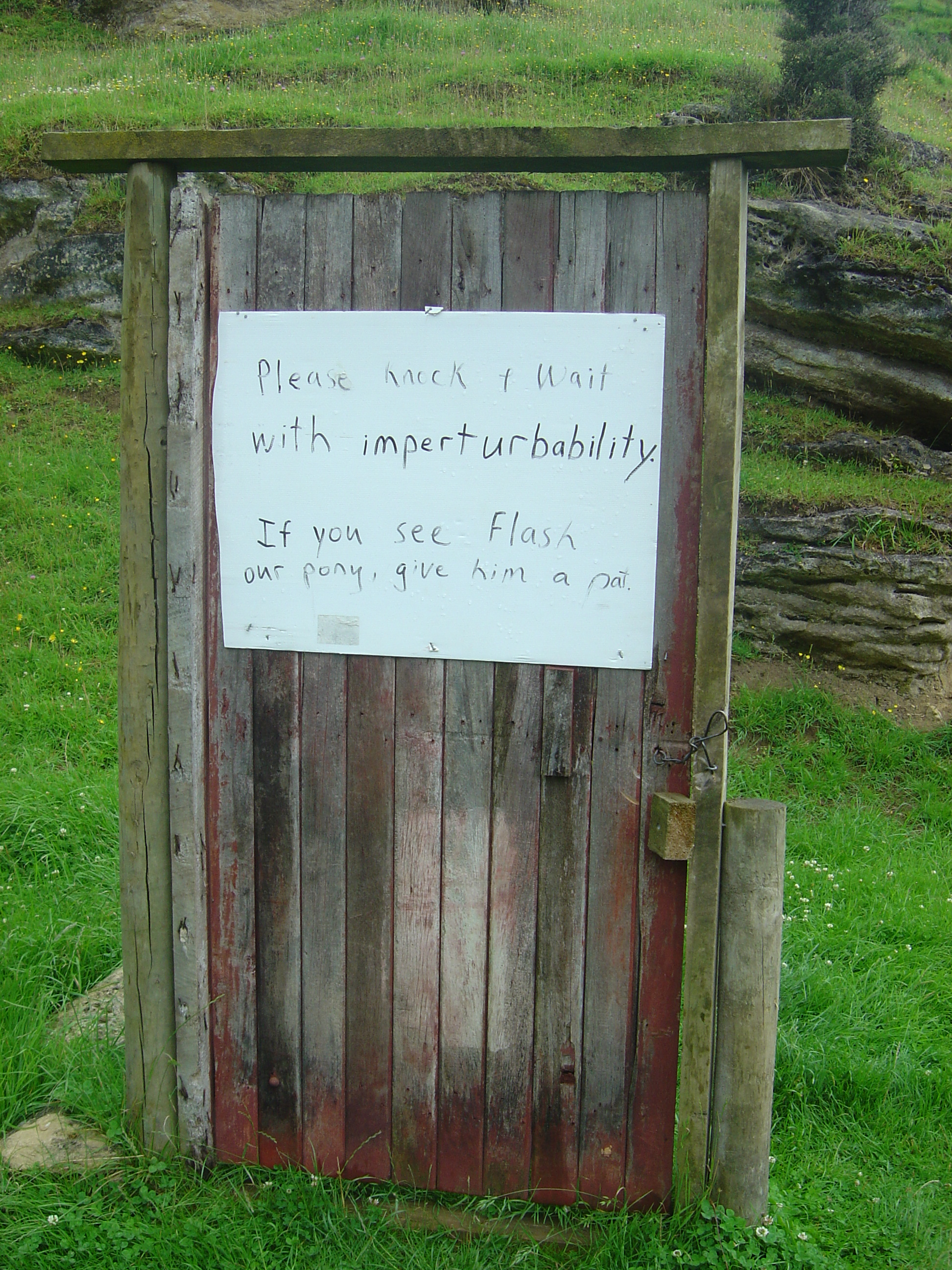
ImperturbabilityA couple of years back, a friend who lives in New Zealand sent me this picture. “Please knock, and wait with imperturbability.” You don’t often see a seven syllable word on a notice like that, not in the middle of a field, not correctly spelled. Seven syllables – the middle line of a haiku waiting to be written.

But it’s the combination of “wait with imperturbability” with what is written underneath that fills me with delight: “If you see Flash, our pony please give him a pat.” Every time I see ponies I think of poor old Flash, hoping for a pat and as I sit here now I’m wondering when I’ve ever waited with imperturbability. It sounds like a good Buddhist type thing to do, but I’m not a Buddhist and I’m rather subject to perturbation (provided it means what I think it means). Maybe that’s the secret of enlightenment: “Knock and wait with imperturbability.” If only I could be sure there was someone at home.

Anyway it’s a word I intend to start using. I could sign my letters “Imperturbably Yours.” Or “How are you feeling today?” – “Quite imperturbable, thank you.” Or song lyrics: “Imperturbable, that’s what you are.” Or maybe I’ll create a new super-hero with imperturbability as his super-power. When trouble comes around, he doesn’t do anything, he just doesn’t give a fuck. “What’s that flying high in the sky? Is it a bird? Is it a plane?” – “Fuck knows.” – “Well you don’t have to be rude, I was just asking.” – “No. That’s his name: Fuck-Knows.” He could have a side-kick with the power of insurmountability. “What happened to him?” – “He died tragically. Fuck-Knows never got over him.”

There would have to be something like Kryptonite to counteract the power of Fuck-Knows’s imperturbability. Apprehensivite would do the trick. Fuck-Knows walks down the street, cool as a cucumber busy not giving a fuck as buildings collapse around him; a train races towards a group of smiling schoolgirls sucking lollipops; an aeroplane is falling out of the sky.

Suddenly a man wearing a yellow fedora with “villain” written all over him (otherwise known as The Calligrapher) sneaks out of a side alley and opens the lid of a box containing a nugget of pure Apprehensivite – a still-glowing fragment of a comet once part of the shattered planet Dread – under the nose of Fuck-Knows. It’s powerful rays permeate his otherwise impenetrable personhood and bingo! “Oh dear,” says Fuck-Knows as if noticing the mounting chaos around him for the first time. “This isn’t so good is it? I’m slightly concerned about how this will turn out.”

Buildings crash to the ground; the train ploughs into the buxom sixth-formers, despite the efforts of the younger girls to save them by forming an outer cordon; the doomed 747 makes a benighted and unsuccessful attempt to land in a car park.

“Bugger,” says Fuck-Knows, just a bit perturbed.

© 2014 Geoff Mead

Written during a Freefall Writing Workshop with Barbara Turner-Vesselago

Share this:

  • Share on X (Opens in new window) X
  • Share on Facebook (Opens in new window) Facebook
  • Share on LinkedIn (Opens in new window) LinkedIn
Like Loading...

Orality and Literacy

Posted by geoffmead on February 23, 2014
Posted in: Uncategorized. Tagged: leadership, literacy, orality, spoken word, storytelling, Telling the Story, Walter J Ong. 2 Comments

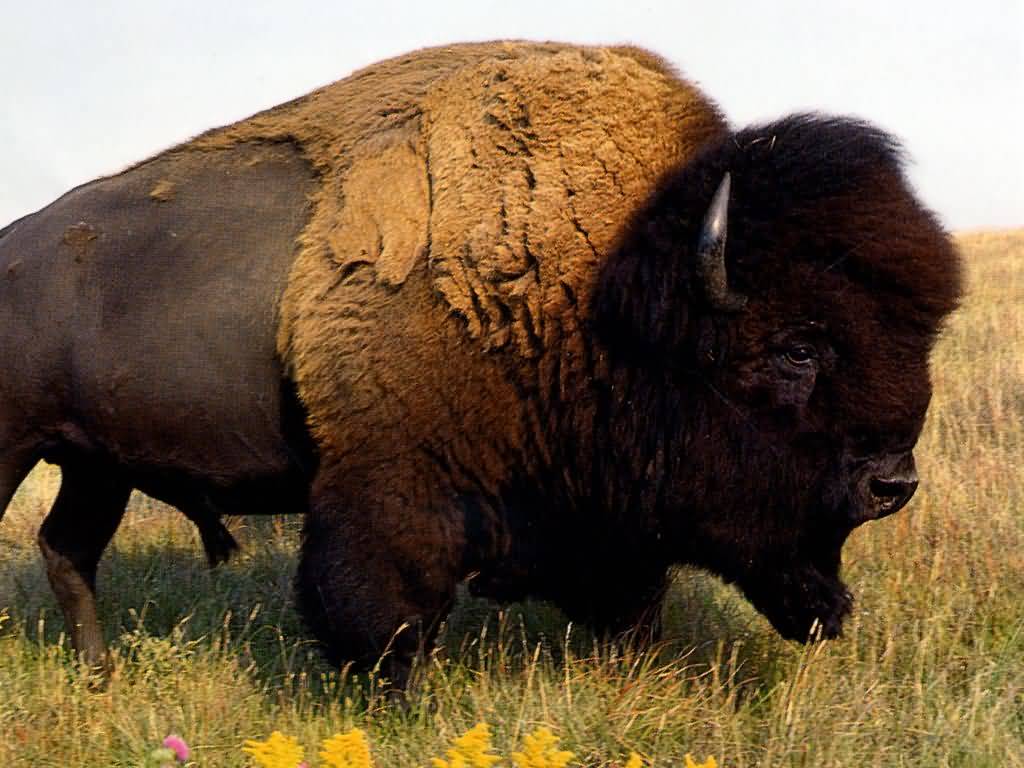
The_Buffalo_Boys_BuffaloThese days there are many ways to tell a story: theatre, dance, music, puppetry, mime, film, books, articles, blogs, emails, etc. The list is almost endless, but at the core of narrative leadership is face-to-face storytelling. Why? Because the more distant the act of narration, the less its impact. Think of the most engaging TED talk you’ve ever watched on the Internet and imagine what it would have been like to have been in the audience when it was recorded. Sharing our stories on Facebook, Vimeo or WordPress is a step up from the monthly newsletter but there really is no substitute for direct oral communication.

In literate societies, the spoken word has largely been displaced by the written word. Few of us come from an unbroken tradition of oral storytelling but that is – incontrovertibly – where the roots of storytelling are to be found. Walter J. Ong in his classic study of the development of language and literacy explains the psychodynamics of the spoken word for our pre-literate ancestors (and indeed for us when we experience it):

Oral peoples commonly, and probably universally, consider words to have great power. Sound cannot be sounding without the use of power. A hunter can see a buffalo, smell, taste and touch a buffalo when the buffalo is completely inert, even dead, but if he hears a buffalo, he had better watch out: something is going on. In this sense, all sound, and especially oral utterance, which comes from inside living organisms, is “dynamic”.

Although similar in many ways, the experience of writing (and reading) a story differs from the experience of speaking (and listening to) a story because, in the former, the relationship between teller and audience is less immediate than in the latter. There can be no eye contact with the writer and no sense of their physical presence as one reads; their words do not fall upon the ear but linger before the eye so they can be read and re-read at will whereas the words of the oral storyteller are ephemeral and must command our attention moment-by-moment.

Listening to someone speaking creates the possibility of a unique form of collective experience: we find ourselves coming into relationship, not just with the speaker and what they are saying, but also with each other. This is vitally important when as leaders we want to bring people together through our words. Oratorical skills and a good story help, of course, but simple words spoken authentically can also create tremendous impact. Ong explains how:

Because in its physical constitution as sound, the spoken word proceeds from the human interior and manifests human beings to one another as conscious interiors, as persons, the spoken word forms human beings into close-knit groups. When a speaker is addressing an audience, the members of the audience normally become a unity, with themselves and with the speaker.

Do not under-estimate this power, which has been used and abused throughout history. Examples of both abound: Christ’s Sermon on the Mount; Alexander the Great rallying his Macedonians before the decisive battle of Gaugemela in 331 BCE; Martin Luther King telling an audience of 200,000 in front of the Lincoln memorial that he had a dream; Adolf Hitler whipping up massed rallies to an anti-semitic frenzy at Nuremburg. Public speaking, of which storytelling is an essential part, is intrinsically neither benign nor malign; it can be put to an almost infinite variety of uses.

This post is extracted from my new book Telling the Story: The Heart and Soul of Successful Leadership, Jossey-Bass, April 2014

Reference: Ong, WJ (2002) Orality and Literacy, Routledge, London

Share this:

  • Share on X (Opens in new window) X
  • Share on Facebook (Opens in new window) Facebook
  • Share on LinkedIn (Opens in new window) LinkedIn
Like Loading...

Sneak Preview

Posted by geoffmead on January 18, 2014
Posted in: Uncategorized. Tagged: Telling the Story, wordle. 1 Comment

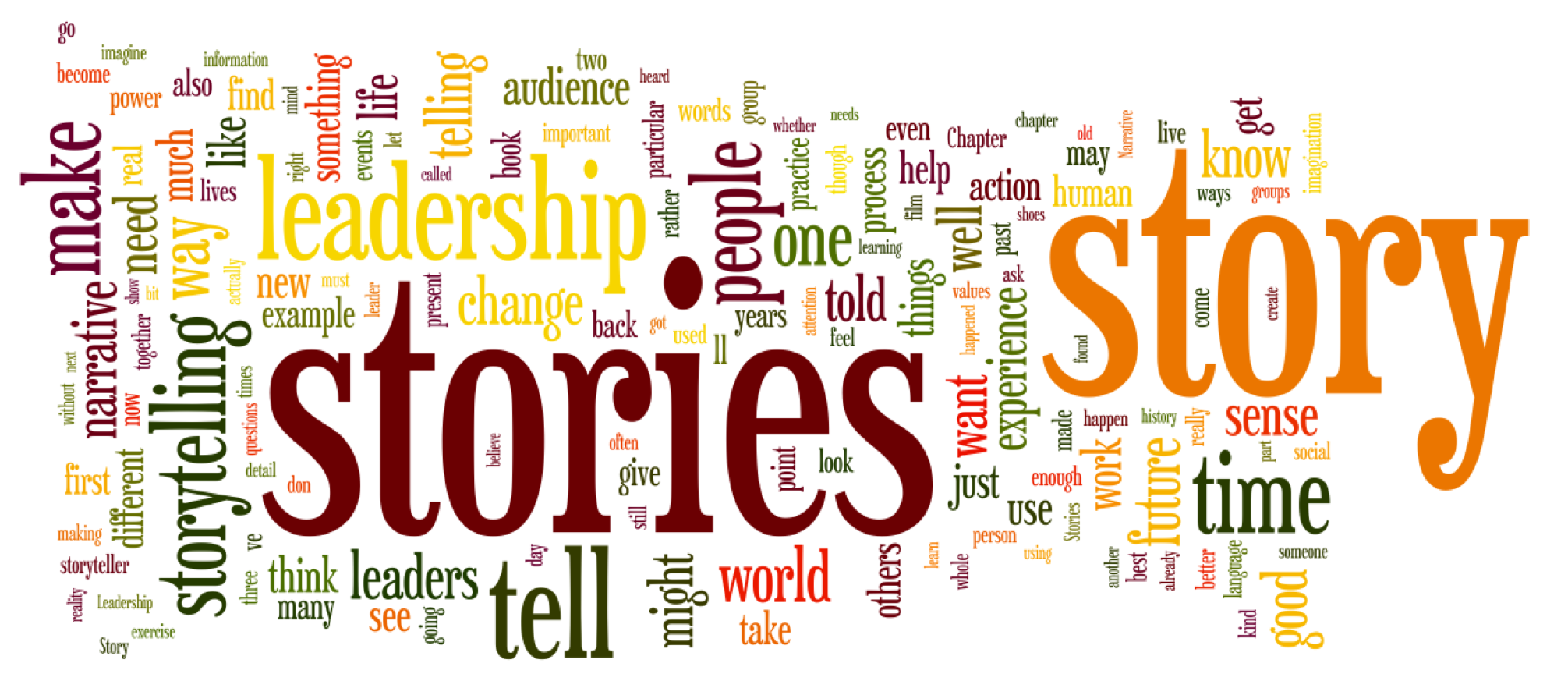
Cropped wordle

A Wordle display of the text of my forthcoming book Telling the Story: The Heart and Soul of Successful Leadership (to be published worldwide by Wiley/Jossey-Bass in April 2014).

[Click on the image for an enlarged view]

Share this:

  • Share on X (Opens in new window) X
  • Share on Facebook (Opens in new window) Facebook
  • Share on LinkedIn (Opens in new window) LinkedIn
Like Loading...

Telling the Story

Posted by geoffmead on December 22, 2013
Posted in: Uncategorized. Tagged: making things real, our stories matter, storytelling and leadership, Telling the Story, writing a book. 2 Comments

A short piece of film about the writing of my new book Telling the Story: The Heart and Soul of Successful Leadership which is coming out in April 2014 under Wiley’s worldwide Jossey-Bass imprint.

Interview, filming and editing by Chris Seeley

Share this:

  • Share on X (Opens in new window) X
  • Share on Facebook (Opens in new window) Facebook
  • Share on LinkedIn (Opens in new window) LinkedIn
Like Loading...

Posts navigation

← Older Entries
Newer Entries →
  • Recent Posts

    • Do Radio
    • Storytelling to touch the Soul
    • Ship of Fools
    • The Compleat Angler
    • Coming Home to Roost
  • Enter your email address to follow this blog and receive notifications of new posts by email.

Blog at WordPress.com.
Coming Home to Story
Blog at WordPress.com.
  • Subscribe Subscribed
    • Coming Home to Story
    • Join 135 other subscribers
    • Already have a WordPress.com account? Log in now.
    • Coming Home to Story
    • Subscribe Subscribed
    • Sign up
    • Log in
    • Report this content
    • View site in Reader
    • Manage subscriptions
    • Collapse this bar
 

Loading Comments...
 

    %d